
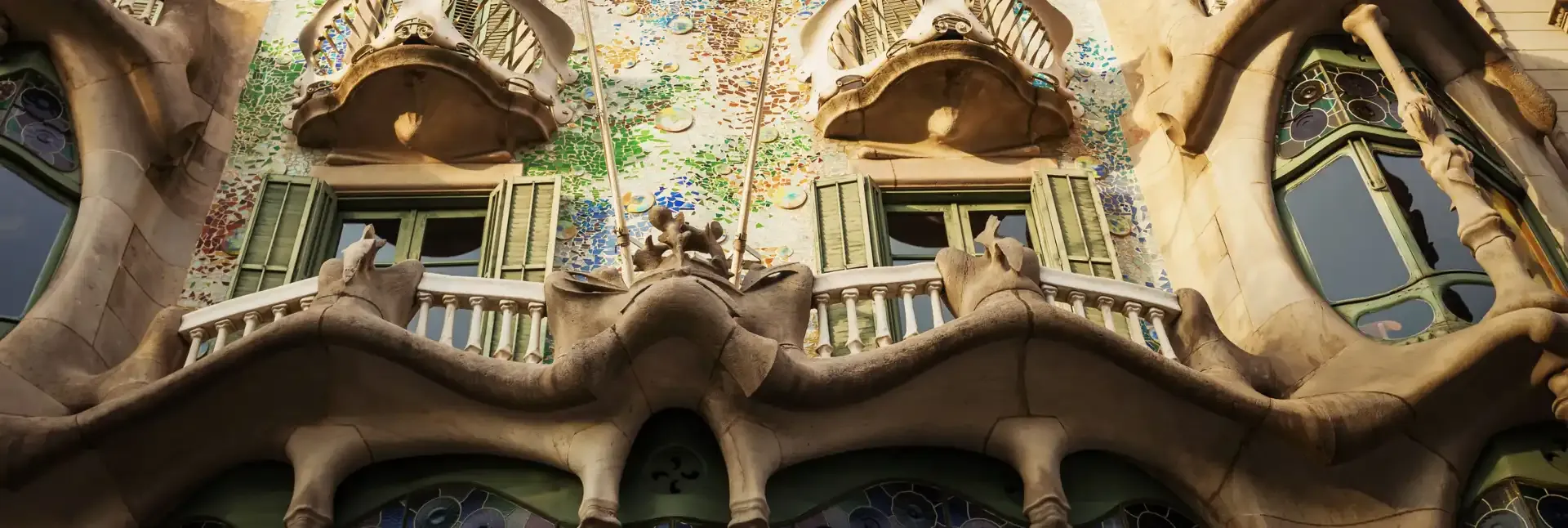
Casa Batlló (Barcelona): the features of modernism in its architecture
The architecture of Casa Batlló occupies a central place when we talk about Catalan modernism and Barcelona’s visual identity. This is not just a striking façade — it is an artistic, technical and symbolic manifesto. When we analyze Casa Batlló and its features as a subject of study, we discover something essential: Gaudí never separates beauty from function. Today, we explain why and how to recognize it.
Visiting Casa Batlló should not be limited to simply “seeing it,” but rather to reading it carefully, because it was designed to move us, yes, but also to improve ventilation, enhance lighting and create better living spaces. It is a total work of art in which stone, iron, glass, ceramics and carpentry interact through an organic logic that refers to the sea, the natural world and legend. That is why the best way to experience it is always with an expert; if you would like us to guide you, we will be delighted to do so.
Why Casa Batlló continues to define modernism
Casa Batlló is part of the Works of Antoni Gaudí included in the UNESCO World Heritage List. The extension of this designation in 2005 incorporated this building as a key piece for understanding the architect’s contribution to architecture and the decorative arts.
However, its importance is not explained solely by institutional recognition. Casa Batlló represents a moment of creative maturity for Gaudí, when the modernist language becomes freer, more expressive and more immersive. It is an explosion of creative freedom, where the architect blurs the boundary between structure, decoration and spatial experience. The house is not perceived as a sum of parts, but as a living organism.
This organic condition is one of the reasons why the building continues to fascinate today’s visitors. In a city full of remarkable architecture, Casa Batlló retains the ability to amaze at first glance and, at the same time, to reveal new layers when observed more carefully. During our tours, we often emphasize this: the first glance captures the color; the second, the movement; the third, the intelligence of the design. And that is precisely where the true cultural experience begins.
The façade: color, movement and material
If there is one iconic image of Casa Batlló’s architecture, it is its façade. Its undulating form is not a mere aesthetic choice: it creates a sense of continuous movement and makes light constantly transform the perception of the building throughout the day, as if the skin of the house were breathing with the city.
The balconies are another of its most distinctive features. This combination of openings, voids and reliefs creates a façade that is deeply theatrical, yet also highly urban: Gaudí understood that this house needed to engage with one of Barcelona’s most elegant avenues and reflect its bourgeois context without losing its radical aesthetic identity.
It is also worth paying attention to the materials. In Casa Batlló, modernism is not limited to form; it is expressed in the way materials enhance one another and in how craftsmanship is integrated into the architectural project. This alliance between art and craftsmanship is one of the great legacies of Catalan modernism.
The upper section completes the visual narrative. The scaled roof and the four-armed cross have long encouraged symbolic interpretations linked to Saint George and the dragon. Although Gaudí rarely imposes a single reading, he creates here a recognizable imagery that blends nature, spirituality and myth.
The interior: a lesson in light, ventilation and ergonomics
Those who focus only on the exterior miss an essential part of the building. The interior of Casa Batlló is, in fact, one of Gaudí’s most brilliant lessons in livability.
The light well is a key element, as it distributes air and light from the large skylight. Gaudí expanded it to ensure that natural light reached every room. Here we clearly see that beauty in Gaudí is not superficial: it emerges from solving real problems with extraordinary creativity.
This concern for natural light is considered pioneering, as is the use of a highly advanced natural ventilation system. To fully appreciate this, we must remember that Gaudí was designing atmospheric experiences long before contemporary architecture turned this approach into a trend.
The main floor perfectly reflects this sophistication. Here we find Mr. Batlló’s office, the famous mushroom-shaped fireplace and the grand living room that opens onto the avenue through a spectacular bay window.
Another key aspect is the craftsmanship, made possible through collaboration with specialists in wrought iron, wood, glass, ceramics and stone. This is evident in doors, railings, stained glass and undulating ceilings, where decorative detail does not interrupt the architecture but rather extends it. In our guided tours, we often point out that in this house, even a door handle seems designed to continue the same formal rhythm. Nothing is isolated; everything belongs to the whole.
The symbolism of Casa Batlló and its cultural interpretation
To discuss Casa Batlló’s architecture without mentioning its symbolism would leave the analysis incomplete. The marine façade, the scaled roof, the references to bones or masks and the constant sense of movement have inspired multiple interpretations. This is precisely what defines the building: Gaudí creates open meanings that stimulate the imagination of every observer, allowing for different interpretations and evocations.
The house can be read as a seascape, as a living creature or as a legendary episode, and none of these interpretations excludes the others. On the contrary, they overlap and enrich the experience.
Furthermore, its symbolic dimension reinforces its role within Barcelona. Casa Batlló is now one of the city’s icons and one of the most reproduced images of Passeig de Gràcia. This prominence is no coincidence. Its silhouette, colors and narrative power encapsulate the idea of a modernist Barcelona: cultured, artisanal and visually bold.
Casa Batlló: key features of Catalan modernism
Casa Batlló helps us understand that Catalan modernism was not just a decorative style, but a comprehensive way of thinking about space. Here we see a preference for curved lines, inspiration from nature, the value placed on craftsmanship and the desire to unify major and minor arts into a total work. We also see something more: a modernity that does not renounce emotion. The house functions, but it also moves us.
From an urban perspective, the building shows that innovation can engage with the city without losing its identity. Gaudí transformed a house on Passeig de Gràcia into a landmark that redefines how we perceive its surroundings. From a technical perspective, it demonstrates how creativity can enhance spatial quality through light, ventilation and ergonomics. And from an artistic perspective, it proves that architecture can be narrative, sensory and symbolic all at once.
That is why, when we recommend buying tickets for Casa Batlló, especially with a guided tour, we do so not only as a must-see attraction, but as a key to understanding Barcelona. Anyone who understands this building gains a deeper insight into modernist Barcelona, the ambitions of its bourgeoisie, Gaudí’s genius and the close relationship between heritage and urban experience. Contacting us to organize this experience is the best way to turn a beautiful visit into a truly memorable and meaningful one.