
What is the history of Casa Batlló? Discover the secrets of this Gaudí masterpiece
Did you know that the history of Gaudí’s Casa Batlló stems from an ambitious urban development plan? And that the area where it stands came to be known as the “Block of Discord”? But most importantly, did you know that the original building was not designed by Gaudí? If you want to learn more about the fascinating history of this monument, stay with us—we’ll tell you everything.
The origins of Casa Batlló in Barcelona’s Eixample district
To understand the history of Casa Batlló, we must first understand the history of Barcelona. The building is located at number 43 Passeig de Gràcia, a street that once connected Barcelona with the then independent Vila de Gràcia. Following the approval of a new and ambitious urban development plan for the city (the Cerdà Plan), this avenue became one of the main arteries of the new bourgeois city. The most influential families began to settle here, and the promenade evolved from a place of transit and leisure into a showcase of social prestige.
The original building was constructed in 1877 by Emili Sala Cortés, an architect and teacher of Gaudí. At that time, the house did not yet display any of the visual features we now associate with the monument. It was a conventional building in line with the styles of its time.
The story took a turn in 1903, when the property was acquired by Josep Batlló i Casanovas, a prominent businessman in the textile sector. His purchase was no coincidence: Passeig de Gràcia was already one of the most sought-after locations in Barcelona, and establishing a family residence there was also a statement of social status. Josep Batlló wanted a unique home worthy of his standing, which is why he turned to Antoni Gaudí.
Gaudí’s renovation: from conventional building to masterpiece
One of the most interesting facts about Casa Batlló’s history is that the original plan involved demolishing the building. However, Gaudí proposed a far more daring alternative: preserving the existing structure and carrying out a complete renovation. This transformation took place between 1904 and 1906, years during which the architect completely reshaped the property.
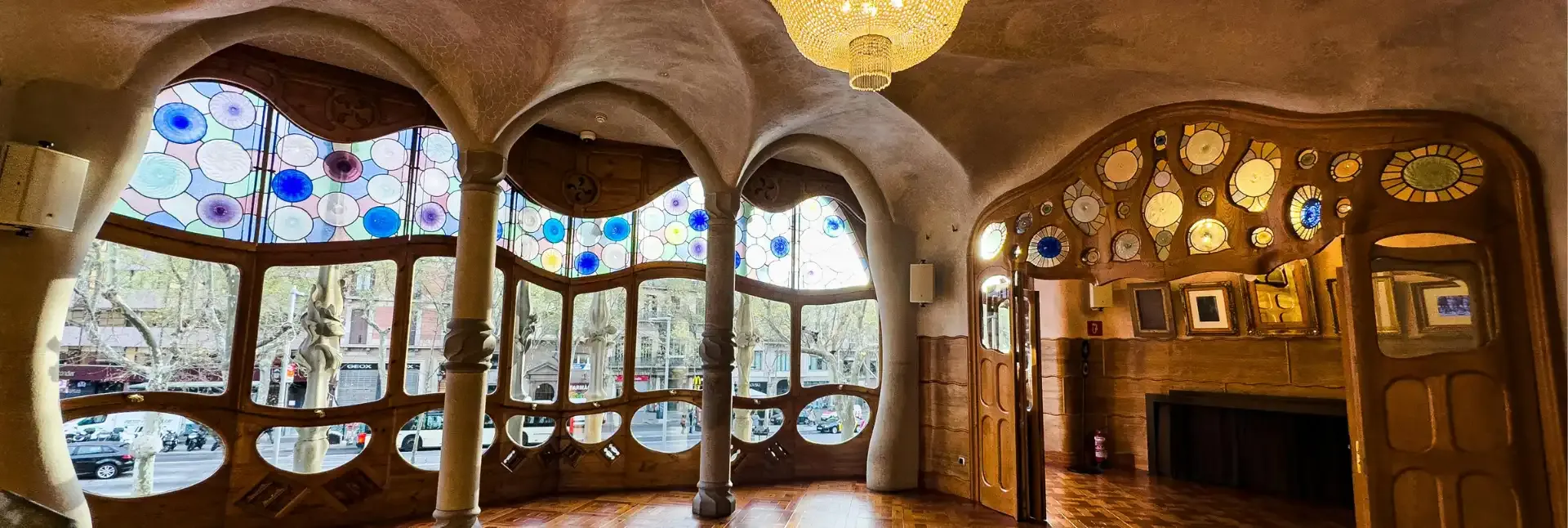
Gaudí modified the façade, redistributed the interior layout, expanded the light well, and turned the house into a total work of art, where functionality and artistic expression merge. Beyond its artistic value, Casa Batlló stands out for a functionality that feels surprisingly modern. This combination of beauty and practicality helps explain why Gaudí is still regarded as an architect ahead of his time.
This work belongs to Gaudí’s period of artistic maturity, when his language became deeply inspired by organic forms in nature and by innovative structural solutions. This maturity explains the sense of continuous movement conveyed by the house. Nothing feels rigid, nothing entirely static. Everything flows: the stone, the ceramics, the windows, the balconies, and even the roof.
The façade, the interior, and the secrets that make it unique
If there is one element that defines Casa Batlló, it is its façade. Its distinctive appearance has given rise to many interpretations over time. Some see marine forms, others associate it with a fantastical world, and some even relate it to skeletal structures—earning it the nickname “House of Bones.”
Gaudí used materials such as stone, glass, and ceramics to create a vibrant and colorful surface. The famous trencadís technique, based on ceramic fragments, produces an iridescent effect that changes depending on the light.
The balconies, with their curved shapes, resemble masks or organic forms, while the roof has been interpreted as the back of a dragon. This symbolic reading connects with the legend of Saint George, deeply rooted in Catalan culture.
Beyond these interpretations, what truly matters is understanding that every detail is part of a unified vision. Gaudí, as a true artist, did not design isolated elements but a coherent whole where architecture, art, and symbolism coexist in perfect harmony.
The Block of Discord and its urban context
Casa Batlló cannot be understood without its surroundings. It is located on a stretch of Passeig de Gràcia known as the Block of Discord, where several notable works of Catalan modernism can be found.
The Barcelona City Council organized urban design awards, which helped shape the Passeig de Gràcia we know today. Different architects built their works on this block, which became not only one of the most prestigious areas of the city but also an open-air work of art that we can still enjoy today.
This striking block includes buildings such as Casa Amatller, Casa Lleó Morera, Casa Josefina Bonet, and Casa Mulleras, in addition to Casa Batlló. Gaudí’s intervention not only met his client’s expectations but also stood out even among already exceptional architectural works.
From private residence to cultural icon
After Gaudí’s intervention, Casa Batlló remained linked to the family that gave it its name for decades. However, from the 1950s onward, the building was no longer owned by the Batlló family, marking the beginning of a new chapter in its history.
During these years, the house changed its function and began to host various spaces dedicated to business and residential activities, which involved internal modifications that gradually moved away from Gaudí’s original design.
The real turning point came in the 1990s, when the Bernat family acquired the property. From that moment, a rigorous process of restoration and conservation was initiated, aiming to recover the original essence of the building and highlight its architectural and cultural significance.
It was in 1995 that the history of Gaudí’s Casa Batlló changed completely once again. The building began to open to the public as an event space, marking the beginning of its transformation into an accessible cultural venue. Shortly after, in 2002, coinciding with the International Gaudí Year, the building officially opened for cultural visits, establishing itself as one of Barcelona’s most important heritage landmarks.
Today, Casa Batlló is not only an icon of modernism but also a living space that welcomes visitors from all over the world. Far from being just a former bourgeois residence, it has become a cultural experience that allows visitors to fully understand Gaudí’s creative universe.
That is why, when planning a visit to Barcelona, it is not enough to admire it from the outside. The true dimension of this work is discovered by exploring its spaces, understanding its architectural solutions, and immersing oneself in its narrative. If you want to truly experience it, the best decision is to visit Casa Batlló and immerse yourself in one of the most fascinating experiences in the city.
Discover Gaudí’s creative universe
Casa Batlló is the perfect combination of an urban development plan, the desire of the bourgeoisie of the time to stand out, Gaudí’s genius, and the Bernat family’s commitment to restoring the originality of this space.
Understanding the history of Gaudí’s Casa Batlló not only enriches the visit but completely transforms the way we perceive it. Every detail gains meaning, every space tells a story.
That is why, if you want to enjoy a complete experience and uncover all its secrets, we encourage you to take the next step: plan your visit, get your tickets to visit Casa Batlló, and let yourself be amazed by one of the most fascinating works in Barcelona.