
Interesting facts about Casa Batlló you may not know
Located at number 43 Passeig de Gràcia, this masterpiece is part of the group of Gaudí monuments recognized by UNESCO as World Heritage Sites and continues to amaze with its ability to blend art, technique, nature, and imagination. In addition, there are countless fascinating facts about Casa Batlló that we are sure you will enjoy discovering before your visit.
If you want to explore the city more deeply and not just scratch the surface, visiting Casa Batlló is an excellent decision—but doing so while knowing its secrets is even better. We will be delighted to accompany that journey with a professional perspective on the history, art, and secrets that make this building a unique jewel of Barcelona.
10 interesting facts about Casa Batlló
It was not built by Gaudí
Did you expect this? It is one of the first surprises worth clarifying. Although today we immediately associate Casa Batlló with Antoni Gaudí, the original building was not created by him.
The original building had already been constructed in the 19th century. What Gaudí did was a complete renovation between 1904 and 1906, commissioned by the industrialist Josep Batlló, who gave him almost total creative freedom. The initial proposal even considered demolishing the building, but ultimately it was transformed from top to bottom.
This detail is important because it changes the way we understand the work. Casa Batlló was not built from scratch, but rather a radical reinvention of a pre-existing house. And that is precisely where part of Gaudí’s genius lies: in his ability to turn a conventional structure into a revolutionary, functional, and deeply poetic architectural piece.
It has several names
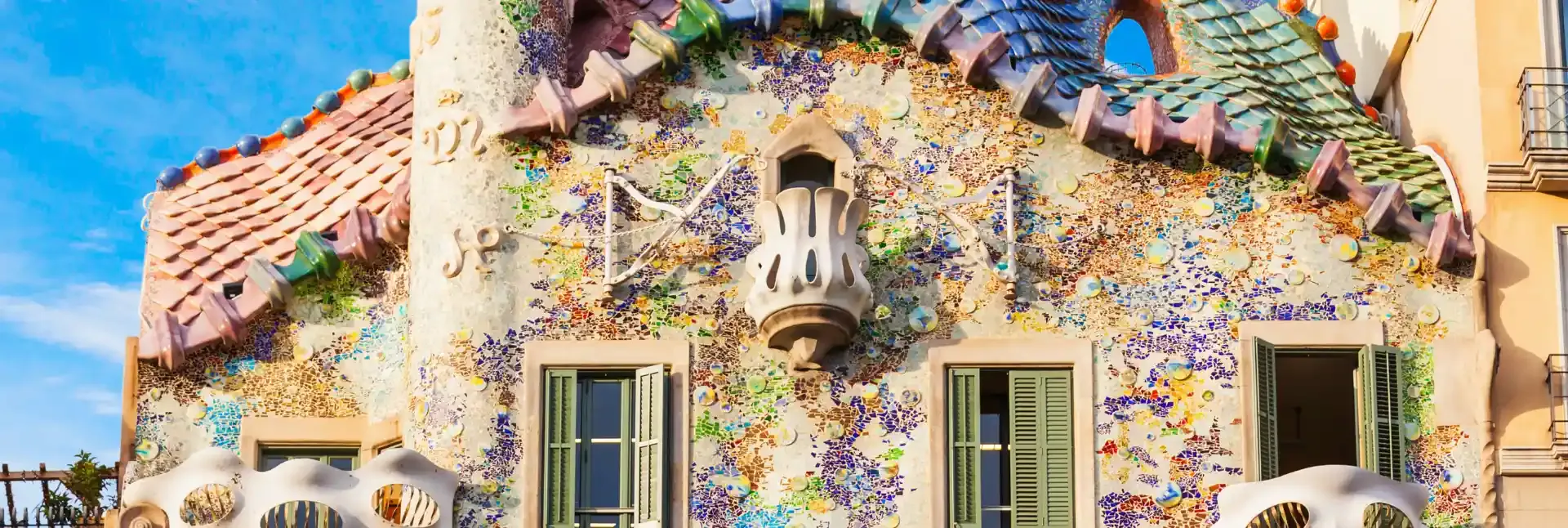
Another of the great curiosities of Casa Batlló is that it does not have just one popular name. In Barcelona, it has been known as the House of Bones due to the appearance of certain columns and balconies on the façade, which resemble skeletal forms. The building is also referred to in heritage sources as Casa dels Ossos, precisely because of this organic and almost anatomical interpretation of its exterior.
At the same time, many people identify it as the House of the Dragon. This interpretation focuses on the undulating roof, covered with ceramic tiles that resemble scales, evoking the back of a mythical creature. Furthermore, a widely accepted interpretation links the building to the legend of Saint George, patron saint of Catalonia: the roof would represent the dragon, and the tower crowned with a cross would symbolize the lance piercing its back.
What is fascinating is that both names coexist without canceling each other out. One refers to the skeletal character of the façade; the other to its legendary dimension. Together, they perfectly capture the essence of Gaudí: an architecture that is at once biological, narrative, and emotional.
It is located in the “Block of Discord”
Casa Batlló is not an isolated building but part of one of the most famous areas of Barcelona’s modernism: the so-called Block of Discord, on Passeig de Gràcia, between Aragó and Consell de Cent. This stretch brings together several buildings designed by leading architects of the time and is named after the artistic rivalry it represented in modernist Barcelona.
This curiosity goes beyond location. Casa Batlló is best understood when seen in dialogue with the surrounding façades. It not only competed visually but also took part in an architectural conversation among designers seeking to leave their mark on the city’s most prestigious avenue. That is why, when visiting, we should not focus only on the building itself but on how it stands out within the ensemble.
It has had many lives
We often think of this space only as a bourgeois residence and later as a cultural icon open to visitors. However, one of the interesting facts about Casa Batlló is that the building has had a much richer history.
For decades, its spaces hosted various commercial and cultural uses linked to Barcelona’s urban life. On the ground floor, there was a period associated with the film industry with Pathé Frères; later came high-end commercial activities such as the Martignole luxury goods brand; and later still, the building housed the Syra Gallery, an important venue in the city’s artistic scene. It also served as the headquarters of the Chamartín animation studios in Barcelona.
This succession of uses reveals something essential: Casa Batlló has not been frozen in time, but rather a living building capable of adapting to different contexts without losing its identity. This explains why it still has such strong appeal today. It is not just an admired monument but also an active part of Barcelona’s cultural and commercial memory.
Highly advanced ventilation techniques
One of its least discussed yet most admirable aspects is the building’s climate intelligence. Gaudí did not limit himself to creating beauty; he designed solutions to improve everyday comfort. Casa Batlló features natural ventilation systems integrated into windows, carpentry, and shutters that allowed airflow to be regulated with surprising precision for the early 20th century. In the inner courtyard, for example, wooden slatted windows could be opened or closed to adjust ventilation.
This shows that Gaudí’s modernity was not only aesthetic. Many of his decisions were based on advanced functional logic: maximizing light, improving air circulation, and adapting architecture to the real needs of its inhabitants.
Light distribution in the inner courtyard
If there is one space that summarizes the technical genius of Casa Batlló, it is the inner courtyard or light well. Gaudí enlarged it so that natural light would reach all rooms evenly and covered it with tiles in different shades of blue: darker at the top and lighter at the bottom. He also made the upper windows smaller and the lower ones larger, balancing light intensity. The result was a uniform distribution of light throughout the building.
This detail is one of the most remarkable curiosities of Casa Batlló because it often goes unnoticed compared to the impact of the façade. However, once understood, it becomes clear that Gaudí worked almost like a lighting designer. He did not simply want to illuminate; he wanted to shape the perception of space.
It was not well received at first
Today, no one questions that Casa Batlló is a masterpiece. However, it is worth remembering that at the time, its groundbreaking style was not unanimously accepted. Gaudí’s proposal was seen by many as excessive, strange, and far from conventional architectural codes. In fact, the project was even questioned for exceeding certain municipal regulations of the time, clearly showing how much it challenged expectations.
This initial reaction is common in works ahead of their time. What we now see as genius may originally have seemed uncomfortable or even incomprehensible. Perhaps that is another important lesson: Casa Batlló was not created to please everyone but to propose a new way of understanding architecture. Time ultimately proved Gaudí right.
The façade is undulating
The undulating façade is not just a decorative whim. It is one of the features that best expresses Gaudí’s rejection of straight lines and his preference for organic forms. The stone façade was sculpted with curved surfaces, and the whole structure conveys movement, as if the building were breathing or gently flowing along Passeig de Gràcia.
This dynamic effect is closely related to the pedestrian’s visual experience. Casa Batlló does not look the same from every angle or under every light. Depending on the time of day, reflections on the glass and ceramics change, and the curves seem to shift. This makes observing the façade a living, evolving experience, very different from that of a rigid, symmetrical building.
Strong marine inspiration
If the façade resembles a skeleton and the roof a dragon, the interior and certain design elements also evoke the marine world. Some spaces feel like underwater environments, with flowing shapes, skylights reminiscent of shells, and undulating ceilings that recall the movement of water. The use of color, the blue gradient in the courtyard, and the immersive atmosphere reinforce this interpretation.
This is one of Gaudí’s greatest strengths: he did not copy nature literally but reinterpreted it. In Casa Batlló, we find echoes of the Mediterranean Sea, organic life, and natural landscapes—filtered through an extraordinary architectural imagination.
Its link to Chupa Chups
Casa Batlló left the hands of the Batlló family in the mid-20th century and, in the 1990s, became the property of the Bernat family, who promoted a full restoration and a new phase of cultural enhancement. For those who may not know, the Bernat family is also the creator of the iconic Chupa Chups candy brand.
Thanks to this restoration and management phase, Casa Batlló has strengthened its international presence and heritage conservation. Did you know about this connection?
Much more than a beautiful façade
After exploring these ten key points, it becomes clear that Casa Batlló cannot be fully understood with just an exterior photo. This is a building where every detail responds to an idea, and that is precisely what makes it such a special visit in Barcelona.
That is why, when planning a cultural experience in the city, it is worth going beyond a quick glance from the street. Understanding these curiosities about Casa Batlló completely transforms the visit. And if we are organizing a thoughtful route through Barcelona’s modernism, this is one of those places where it is worth taking the time to stop.
To fully enjoy it with context, it is always recommended to buy Casa Batlló tickets in advance and include it as part of a quality guided visit. That is where you truly appreciate everything that is often missed at first glance.